
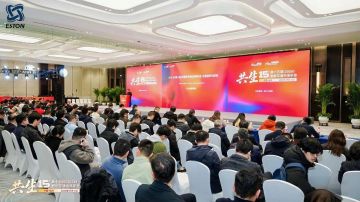
On March 5, 2026, at the Forum on Innovation and Application of Vehicle‑Road‑Cloud Integration and New‑Generation Transportation Infrastructure during the 15th (2026) Intelligent Transportation Market Annual Conference, Du Xiaoping delivered a keynote speech entitled Vehicle‑Road‑Cloud Integration Is Moving from “Top‑Level Strategy” to “On‑Ground Implementation”.
Du is Chief Technical Expert for Vehicle‑Road‑Cloud Integration at the National Intelligent Connected Vehicle Innovation Center, Chief Expert of the Cloud Control Platform at the Western Science City ICV Innovation Center, and Professor at the School of Software, Beihang University.
With the theme of “soaring to the top and standing firm on the ground”, he unraveled the development logic of vehicle‑road‑cloud integration, clarified its top‑level strategic positioning (“soaring to the top”) and practical implementation path (“standing firm on the ground”), and responded precisely to pain points and doubts widely raised in the industry.Combining industrial demands, planning concepts, and practical cases across China, he systematically explained the core architecture, basic conditions, and promotion phases of vehicle‑road‑cloud integration, breaking the misconception that it “lacks application scenarios and cannot be monetized”.This provided a new perspective for the industry to break development bottlenecks and advance vehicle‑road‑cloud integration from national strategy to practical implementation.
The concept of vehicle‑road‑cloud integration is neither very new nor long‑standing.It was first formally used in the Technical White Paper on Vehicle‑Road‑Cloud Integrated Fusion Control System published in September 2020.The Version 2.0 white paper released in January 2023 simplified the title to White Paper on Vehicle‑Road‑Cloud Integration System.
Notably, the cloud control basic platform—the core hub of the vehicle‑road‑cloud integration system—appeared even earlier.In February 2020, the national Intelligent Vehicle Innovation and Development Strategy already defined the cloud control basic platform as urban transportation infrastructure.Vehicle‑road‑cloud integration is not a single specific project, but a technological path driving the transformation of the entire industry.
Among them:
Currently, many people argue that vehicle‑road‑cloud integration lacks business models and clear application scenarios, questioning the feasibility of this technical path.However, the sharing by experts at this conference is reassuring: it fully proves that vehicle‑road‑cloud integration is not valueless—on the contrary, it contains many tangible application highlights.From a macro industrial perspective, its explicit value across the entire industry has simply not yet become sufficiently obvious.
Looking at the development of vehicle‑road‑cloud integration:All industrial transformations or project promotions start with clear demand.Research without demand is merely empty exploration.Even if research solves individual pain points, it is far from enough for the whole industry.Industrial development requires overall coordination, so top‑level planning is essential.After top‑level planning is formulated, implementation does not need to be completed in one step, but must be gradually rolled out and scaled up in strict accordance with the plan to achieve the ideal effect.
The demand for vehicle‑road‑cloud integration falls into three categories.
At present, vehicle travel faces many problems:limited blind‑spot and over‑the‑horizon perception, poor information transmission, physical perception bottlenecks at the vehicle end, plus information silos and decision‑making conflicts.These ultimately affect the safety, efficiency and comfort of travel.
From the vehicle perspective, single‑vehicle intelligence only achieves local optimization.Nearly 10,000 autonomous vehicles worldwide are in testing, but many hidden dangers exist in real operation.Internal data shows frequent minor issues, and users often report malfunctions.The limitation of single‑vehicle intelligence is limited vision and insufficient information; relying solely on on‑board perception cannot meet safe and efficient travel needs.
To solve this, roadside enhanced perception and multi‑vehicle coordination are needed to compensate for the limitations of single‑vehicle intelligence—this is the traditional concept of cooperative vehicle‑infrastructure system (CVIS).Today, CVIS has two layers of meaning.On January 17, 2023, three societies (highway, automotive, and communications) jointly issued the Collaborative Development Framework for Cooperative Vehicle‑Infrastructure Autonomous Driving Systems (Vehicle‑Road‑Cloud Integration System), equating CVIS with vehicle‑road integration.They are essentially the same: the transportation sector calls it CVIS, and the industry and information technology sector calls it vehicle‑road integration.However, the industry still mostly understands CVIS in the traditional sense—mainly collaboration between vehicles and roads.
In the traditional CVIS model, if each party makes decisions independently after obtaining information, decision conflicts easily occur (e.g., vehicles stopping at intersections due to conflicting decisions).To solve this, vehicle‑road integration is required:digital signal to vehicles, over‑the‑horizon perception, vehicle‑cloud coordinated scheduling, dynamic driving planning, etc., to effectively meet various travel needs.
Throughout the four industrial revolutions, each has revolutionized the automotive industry:from the birth of automobiles and assembly‑line mass production, to mechatronics and lean production, to the Industry 4.0 era.Intelligent connected vehicles, centered on cyber‑physical systems (CPS), deeply integrate the physical and digital worlds—and have become a focus of global strategic layout.
Over more than 130 years since the birth of the automobile in 1886, China has long been passive in the traditional automotive industry, with substantial profits flowing overseas due to core patents and key components controlled by developed countries.In the past decade, China’s new energy vehicles have achieved a leapfrog development, shifting from being “choked” to self‑controlled and independent.
As the industry evolves from traditional vehicles and IoV to intelligent connected vehicles, and finally to intelligent mobile and application terminals, China has moved from follower to parallel runner, and now to a critical stage of leapfrogging.Consolidating existing advantages and maintaining the initiative in industrial development has become a major task.The recent new regulations issued by the United States, which explicitly aim to recapture the initiative in the automotive industry from China, also confirm the urgency and necessity of this industrial transformation.
Traditional transportation is gradually upgrading to intelligent and smart transportation.The core is to fully digitize physical entities, aggregate data on a unified platform, build a “data power station” with data as the core factor, and mine data value to form a digital driving track and high‑value fused data.This then empowers vehicle operation and the whole industry, maximizing transportation efficiency.
The key to smart transportation is the transition from traditional to digital transportation.Digital transportation is still in its infancy, evolving from “digital transportation” to “smart transportation”.To meet industrial transformation and development, three core steps must be completed in sequence:
To address the above demands and pain points, solutions must rely on top‑level planning, not just single‑point projects and short‑term problems.Top‑level planning must be global and holistic to truly support systematic industrial transformation.
Furthermore, planning must be demand‑driven and unified, and promoted gradually during implementation.
The path is as follows:
The core idea of top‑level planning is layered decoupling and cross‑domain sharing.Each party first completes its own construction to optimize single‑vehicle intelligence, then promotes cross‑domain and cross‑object data fusion and value sharing.Based on single‑vehicle intelligence and roadside infrastructure digitization, interoperability is achieved through CVIS and vehicle‑road integration.
At this stage, intelligent vehicles are basically electrified, intelligent, and connected, able to obtain external information for operation.Road construction used to be mostly passive; now it is gradually transforming to digital, intelligent, and connected to achieve mutual empowerment.
However, early construction suffered from inconsistent standards, unclear services, and difficult cross‑domain collaboration.Roadside devices in many pilot zones only served a small number of test vehicles and were difficult to scale.Even if projects passed acceptance, systems were incompatible and standards inconsistent, making overall value hard to realize.To solve this, the industry moved from promotion to testing and demonstration; the state issued many policies to support transformation and continued to advance vehicle‑road integration pilots.
Several key milestones:
In practice, digital traffic signals to vehicles and dynamic traffic signal control are important empowerment scenarios.In the past, traffic police information networks were relatively closed;driven by five national ministries and supported by two national standards and two group standards, information barriers have been gradually removed, laying a foundation for large‑scale application.
At present, the national top‑level planning is very clear:vehicle‑road‑cloud integration is an inevitable and important path for industrial transformation.However, many cities still lack a deep understanding of its connotation and positioning.
The core of vehicle‑road‑cloud integration is to adopt a unified CPS cyber‑physical architecture, covering:
Construction shall avoid redundant investment:existing traffic‑related infrastructure data (traffic management, emergency rescue, mapping, positioning, meteorology, etc.) shall be accessed to common platforms, fused, and used to support industrial applications.
Cloud control applications are divided into three categories:
This architecture strengthens layered decoupling and role‑specific responsibilities, and realizes cross‑domain sharing and value empowerment through networks and common platforms—a key condition for 落地.
For real implementation, vehicle‑road‑cloud integration must meet three basic conditions:
Only when these three conditions are met can a genuine vehicle‑road‑cloud integration architecture be formed:unified architecture and standards, gradually dedicated networks, compatible vehicles, clear roadside grading, a single shared platform, and full‑domain reuse of infrastructure—ultimately supporting all future industrial applications.
In terms of development goals, priority should be given to building a value closed loop rather than rushing for a commercial closed loop, focusing on:
At the urban level, the architecture is centered on the urban cloud control basic platform, supported by digital tracks and data power stations, providing three categories of services: vehicle, traffic management, and data empowerment.The same architecture applies to expressways;with unified standards and interfaces, they can interconnect with urban platforms, realizing cross‑scene user and data connectivity and promoting national integrated transportation operation.
Implementation is divided into three phases:
From early demonstration zones to vehicle‑road integration pilots, and then to digital transformation of transportation infrastructure, relevant work has been carried out in all provinces and cities nationwide.To solve inconsistent standards, authorities have issued a series of construction guidelines.
A prominent difficulty in current practice is low participation by automakers.After continuous promotion, 15 automakers have reached consensus in the high‑level autonomous vehicle demonstration zones in Beijing and Chongqing, among which 7 have clearly included related technologies in mass production plans.To achieve full‑domain unification, urban platform entities have formed alliances to promote collaboration under unified standards.Scenarios such as emergency response and incident handling have verified application value in real road tests.
Wuxi, Beijing and other cities have proven the effectiveness of vehicle‑road‑cloud integration with real data.Even though Qingyuan’s system was not fully completed during the Spring Festival travel rush, applying relevant concepts alone achieved remarkable results, fully confirming the feasibility and practicality of this path.
In the promotion process, vehicle‑road‑cloud integration still faces many practical challenges, focusing on three core aspects:
Industrial ecology is still in the early stage with inconsistent industry cognition.It is necessary to fully listen to industrial demands, focus on real needs, strengthen concept popularization and consensus building, and accelerate ecological maturity.
The cloud control basic platform is critical but still weak in capability.Based on improved cognition, it is necessary to strengthen platform compliance acceptance and enhance core capabilities: data aggregation, service provision, and cross‑platform interconnection.
Roadside facilities are insufficient in scale and uneven in quality.Pilots in Beijing and Chongqing have proven that high‑standard construction gains recognition from automakers and supports mass production.By adhering to classified construction, strict standards, and steady expansion, data sharing and large‑scale application can be realized.
From an development perspective:
Although funding shortage is a real problem, it can be addressed by value first and early monetization in partial scenarios to attract ecological partners for joint investment.We will explore a value closed loop:roadside facility builders supply roadside infrastructure and perception data to common platforms;platform operators fuse data to empower industry applications, ultimately achieving sustainable development.











合作咨询
QQ 5257885在线咨询
合作咨询热线:
13779938068