

In October 2025, the U.S. Department of Transportation (USDOT) released an official Fact Sheet titled Perception Sharing for Cooperative Driving Automation (CDA). Compiled and issued jointly by the Federal Highway Administration (FHWA) and its affiliated Turner-Fairbank Highway Research Center (TFHRC)
The document can be summarized in one sentence: leveraging V2X direct communication and cooperative perception to enhance the environmental awareness of human drivers and autonomous driving systems, thereby preventing collisions and reducing casualties.
Why do U.S. regulators attach great importance to V2X-based cooperative perception? The Fact Sheet opens with a stern safety statistic: in 2023, pedestrian and cyclist fatalities accounted for approximately 21% of all traffic deaths in the United States. A core technical root cause is perceptual limitations — both human drivers and autonomous vehicles suffer from blind spots and obscured views, failing to detect vulnerable road users in a timely and accurate manner, which leads to collisions.
Combined with relevant government plans and pilots across the EU, Japan, China and Hong Kong in recent years, it is undeniable that the large-scale application of autonomous driving cannot be achieved without vehicle-road collaboration.
The large-scale deployment of vehicle-road collaboration has long faced a bottleneck: massive infrastructure investment and sustainable operational support require continuous funding. Yet a stable revenue model has remained elusive.
As the U.S. steadily advances relevant applications, it is urgent for China to explore a practical, sustainable development model to secure a leading position in the autonomous driving era. This article proposes an innovative, feasible framework to transform vehicle-road collaboration from a "cost-only initiative" to a profitable ecosystem.
Prerequisite: A certain penetration rate of factory-installed PC5-based V2V direct communication technology is mandatory; otherwise, the model cannot function.
The author firmly advocates a "vehicle-end first" strategy: prioritize the development of vehicle-side V2V communication (which requires no road-side infrastructure) to form an independent commercial closed loop for the automotive industry, then accelerate road-side construction based on this foundation. V2V large-scale implementation underpins both vehicle-road collaboration and mass autonomous driving adoption — NVIDIA, for instance, is already researching cooperative autonomous driving large models built on V2V technology.
The revenue-generating framework for road-side facilities proposed in this article also relies on vehicle-side participation, named the Early Warning Point System. It requires top-level national coordination and close collaboration among all stakeholders to form a complete commercial closed loop.
All messages broadcast by road-side infrastructure carry a unique Application Identifier (AID):
These AIDs are accurately recognized by vehicle-mounted V2X On-Board Units (OBUs). The vehicle integrates road-side perception data into advanced driver-assistance or autonomous driving systems, triggering early warnings and avoidance commands for drivers and automated vehicles when risk thresholds are met. This aligns with the operating logic of FHWA’s self-developed CARMA cooperative perception system.
If a warning or avoidance decision incorporates road-side data support, the vehicle automatically generates an Early Warning Point, which is uploaded to the cloud in real time.No new cloud platform is needed: the existing mature national RTM new energy vehicle remote monitoring platform can be reused. Warning points are first recorded on OEM platforms, then synchronized to the national platform.
This solution delivers two key advantages:
A supplementary solution for fuel vehicles: China is formulating a new mandatory national standard for real-time monitoring of intelligent connected vehicle assisted driving systems (tentatively named the ICV RTM platform). The Early Warning Point system can be fully integrated with ICV RTM to cover all intelligent connected vehicles.
When an early warning prevents an accident and casualties, overall social costs are reduced. The primary beneficiaries are insurance companies and auto OEMs:
Assumptions:
Annual stable national revenue for road-side development reaches approximately 8.2125 billion RMB. This figure grows continuously as V2X penetration rises, creating a win-win scenario: insurers reduce compensation costs and boost profits, while the state secures sustained funding for smart road infrastructure. Massive additional economic benefits will also drive the development of upstream and downstream industries.
When V2X penetration reaches 50% or higher, traffic accidents and insurance payouts will drop sharply, making the insurance industry a core beneficiary.The U.S. National Highway Traffic Safety Administration (NHTSA) previously estimated: full nationwide V2V installation on light vehicles could prevent 420,000 to 590,000 collisions and save 955 to 1,321 lives in the 30th year of implementation, cutting social costs by 52 to 71 billion USD (about 360 to 490 billion RMB).
Drawing on the high-speed rail development model: joint investment by the central government and local authorities in the early stage, with social capital introduced for long-term operation. Priority road-side deployment covers intersections, pedestrian crossings without traffic lights, school/hospital/commercial zones, and highway merge/diverge sections.
Again, the core prerequisite remains sufficient V2V (PC5) factory-installed penetration — proving once again that vehicle-side advancement must lead road-side development.
As highlighted in the FHWA Fact Sheet, vulnerable road users face fatal risks due to perceptual limitations.
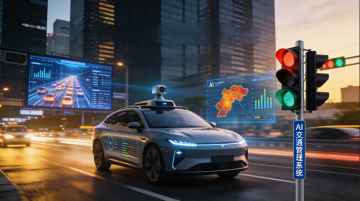
The solution proposed is cooperative perception: road-side infrastructure shares real-time data with vehicles to detect pedestrians, other vehicles, obstacles and road hazards beyond onboard sensor range. This enhances situational awareness, improves collision prevention, and optimizes path planning, speed control and energy efficiency for autonomous driving systems.
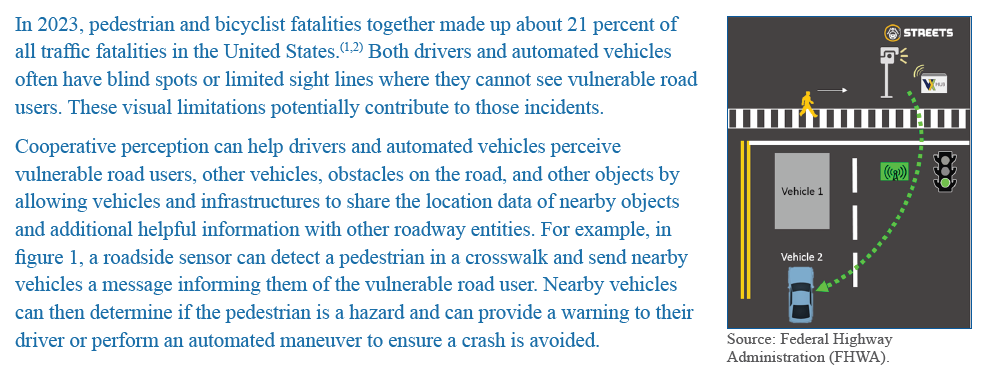
FHWA verified this concept via empirical tests on its self-developed CARMA system. Nine test scenarios were designed for vulnerable user protection, featuring pedestrians crossing roads at varied angles with a stationary test vehicle (with blocked sightlines in partial scenarios). Road-side facilities operated the CARMA Streets and V2X Hub systems for data processing and direct communication, while the test vehicle ran the CARMA Platform for cooperative perception.
 Independent evaluators from the Volpe National Transportation Systems Center assessed data consistency, latency, and full-link accuracy from pedestrian detection to path planning.
Test results demonstrated exceptional system performance: the average latency from road-side detection to vehicle decision-making was less than 6.5 milliseconds, enabling instant safety responses to avoid collisions.
FHWA outlined four key follow-up priorities:
Full details are available in the official Fact Sheet and the open-source GitHub repositories for the CARMA Platform and V2X Hub.
FHWA’s pragmatic roadmap for cooperative perception addresses auto OEMs’ core demands for authentic, accurate and stable road-side data. It is critical for China to establish a regular monitoring mechanism for road-side infrastructure, with OEMs playing a key supervisory role.
An actionable proposal for domestic pilots: abandon the traditional "demonstration zone" model, and deploy small-scale road-side facilities in key high-risk areas. Recruit private car owners nationwide for large-scale trials via both factory-installed mass-production solutions and aftermarket V2X OBUs. Integrating end users into real-world testing builds market recognition for V2V and I2V technologies, while providing OEMs with valuable operational data and user feedback — laying a solid foundation for technological innovation, patent layout and industrial competitiveness.
Subsidies from central and local authorities are recommended to incentivize OEMs and car owners to participate in trials.
As early as 2016, NHTSA promoted the enactment of FMVSS 150, mandating V2V installation on all U.S. light vehicles (originally based on DSRC technology). With the rapid rise of C-V2X and the FCC’s nationwide phase-out of DSRC, the original mandate was withdrawn. Today, the U.S. is accelerating C-V2X deployment, and an updated version of FMVSS 150 may be forthcoming. As the birthplace of C-V2X technology, China should further accelerate its industrial implementation.








合作咨询
QQ 5257885在线咨询
合作咨询热线:
13779938068